

Wilmington homeowners deal with roughly 45 inches of rain a year, plus repeated freeze-thaw swings every January and February that stress seams, fasteners, and fascia boards.
That combination is exactly why gutter lifespan varies so much from house to house, even on the same street.
If you’re asking how long do gutters last, the honest answer depends on material, installation quality, and how much Delaware weather your system has already absorbed.
Most homeowners don’t think about their gutters until water starts spilling over the edge during a storm. By then, the damage to your fascia, siding, or foundation may already be underway.
Knowing your gutter system’s realistic lifespan and the warning signs that appear before failure lets you plan a replacement before winter weather hits, not during an emergency.
What Wilmington’s Weather Does To Every Gutter Material Over Time
Not all gutters age the same way. Here’s what Rain Drainz typically sees across New Castle County homes:
- Aluminum sectional gutters: 15 to 20 years, shorter if joints weren’t sealed properly during installation.
- Seamless aluminum gutters: 20 to 25 years when installed with correct pitch and maintained twice a year.
- Vinyl gutters: 10 to 15 years before UV exposure and winter cold cause brittleness and cracking.
- Steel gutters: 20 years on average, though rust can shorten this near coastal moisture.
- Copper gutters: 50 years or more, with many Wilmington homes near Trolley Square still running original copper systems from decades ago.
So how long do aluminum gutters last specifically? Standard sectional aluminum typically holds up for 15 to 20 years, while seamless aluminum extends that range because it has fewer joints where leaks and separation can start.
Fewer Seams, Fewer Failures: Why Seamless Gutters Outlast Sectional Systems
How long do seamless gutters last is one of the most common questions we get during estimates, since seamless is now the standard for most Wilmington installations.
A properly installed seamless aluminum system typically lasts 20 to 25 years, roughly 5 years longer than comparable sectional gutters.
The difference comes down to fewer connection points. Every seam in a sectional system is a potential leak point once sealant ages and shrinks.
Seamless gutters are custom-formed on-site to fit your roofline, which removes most of those failure points from day one.
Signs It’s Time to Replace Your Gutters Before the First Frost
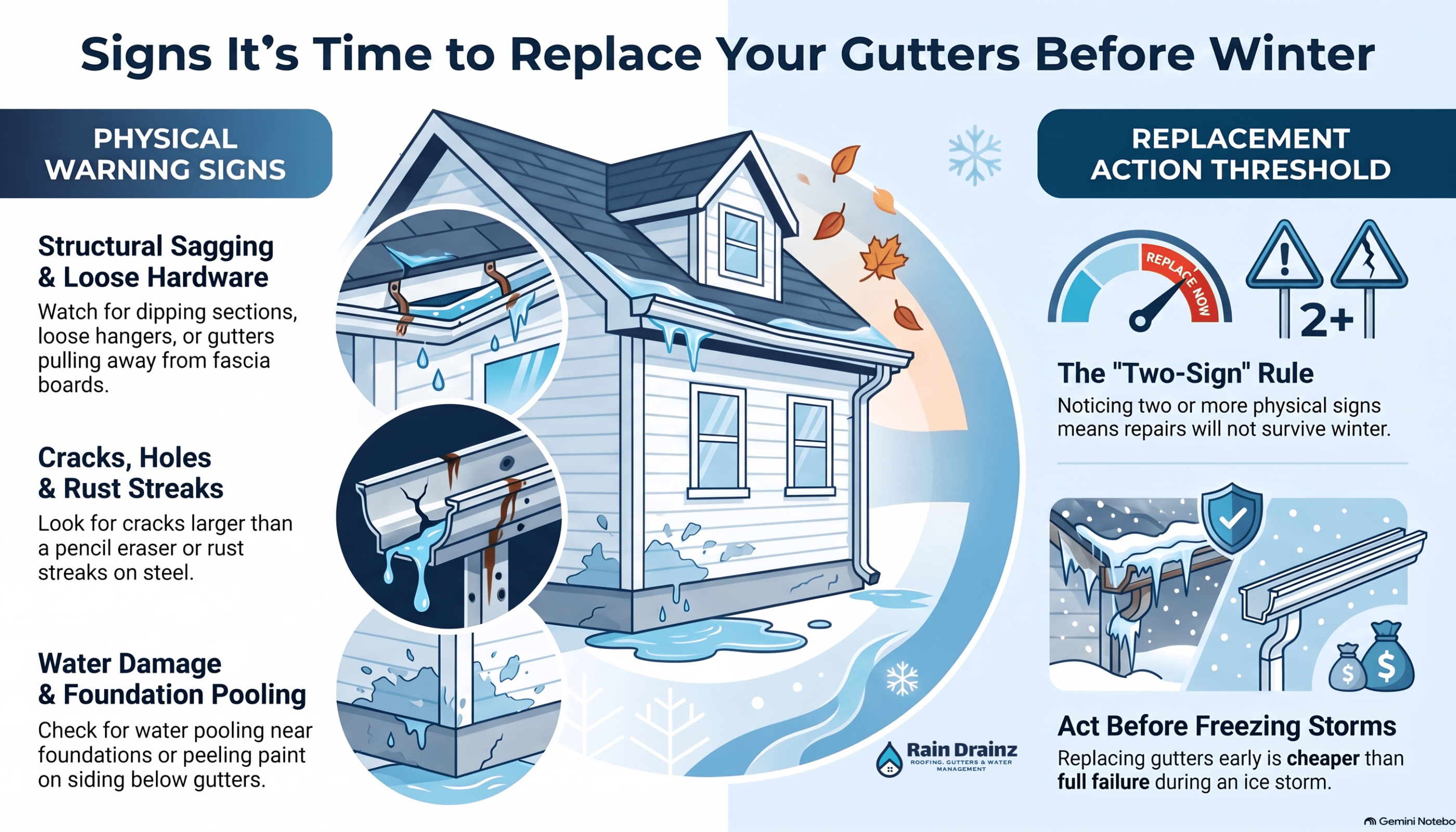
Age alone doesn’t tell the whole story. Knowing when to replace gutters means watching for physical signs, regardless of how old the system is:
- Visible sagging or dipping sections along the roofline.
- Cracks, splits, or holes larger than a pencil eraser.
- Water pooling near the foundation after rainfall instead of draining away.
- Rust streaks or orange discoloration on steel systems.
- Nails, screws, or hangers pulling loose from the fascia board.
- Peeling paint or water stains on siding directly below the gutter line.
If you notice two or more of these signs, repairs alone usually aren’t enough to get the system through another Delaware winter.
If your gutters are sagging, pulling away, or separating at the roofline, catching it now is far cheaper than waiting until a section fails completely during a January ice storm.
Contact Rain Drainz for a free gutter inspection while fall installation schedules are still open.
Why Gutters Pull Away From the Roofline in the First Place
Sagging and separation rarely happen overnight. Clogged debris adds weight, fasteners loosen with age, and rotted fascia boards lose their ability to hold the system in place. Understanding what causes gutters to pull away from the roofline explains the mechanics behind it, and it’s worth knowing before you decide between a repair and a full Gutter replacement.
Homes in older Wilmington neighborhoods with settled fascia boards are especially prone to this, since decades of freeze-thaw movement have already shifted the wood slightly out of true.
20-Year-Old Gutters: Patch Job or Past Their Prime?
A 20-year-old aluminum system is right at the edge of its expected lifespan, and the decision usually comes down to condition rather than age alone.
If the gutters are still straight, properly pitched, and free of cracks, a repair and cleaning may buy another season or two.
But if you’re seeing sagging, separation, or recurring overflow despite regular cleaning, repair becomes a short-term patch on a system that’s already past its structural prime.
Our crews walk the full roofline during every estimate specifically to make this call honestly, not to push a sale.
Protecting a New Gutter System After Replacement
Once new gutters are installed, the biggest factor in hitting that full 20-to-25-year lifespan is keeping debris from accumulating in the trough.
Do gutter guards work in Wilmington, DE? We break down which mesh types actually hold up against our mix of spring pollen and heavy autumn leaf drop from oaks and maples.
Pairing a new seamless system with the correct guard type is one of the simplest ways to stretch your investment toward the longer end of its expected lifespan instead of the shorter end.
Thinking about pairing a replacement with gutter guards? Rain Drainz evaluates your roofline, tree canopy, and pitch together during one visit, so you’re not guessing which system fits your home.
See reviews from your neighbors on our Google Business Profile before scheduling your free estimate.
Key Takeaways
- Seamless aluminum gutters typically last 20 to 25 years in Wilmington, while sectional aluminum averages 15 to 20 years.
- Copper systems can exceed 50 years, while vinyl degrades faster under Delaware’s freeze-thaw cycles.
- Sagging, cracks, rust, and pulling away from the fascia are stronger replacement indicators than age alone.
- Pairing new gutters with correctly matched guards helps the system reach its full expected lifespan.
Getting Ahead of Winter Before Your Gutters Fail
A sagging, cracked, or pulling-away gutter system won’t improve once ice and snow add extra weight to an already weakened structure.
Wilmington’s freeze-thaw winters are unforgiving on fasteners and fascia boards that are already compromised, which is why fall is the smartest time to address warning signs rather than wait.
Rain Drainz has spent over a decade evaluating roof-to-ground water management across New Castle County, and most replacement decisions come down to the specific condition of your fascia, pitch, and material age rather than a one-size-fits-all timeline.
Call Rain Drainz today to schedule a free gutter inspection before the first frost puts your home’s drainage at risk this winter.
Frequently Asked Questions
Should I replace 20-year-old gutters?
Yes, 20-year-old gutters should be evaluated closely for replacement, especially if they show sagging, cracking, or separation from the fascia, since most aluminum systems reach the end of their expected lifespan around this point.
A gutter that’s still straight and properly pitched may handle another season or two with repairs, but recurring overflow or visible wear at this age usually signals it’s more cost-effective to replace than to keep patching.
What is the average lifespan of seamless gutters?
The average lifespan of seamless gutters is 20 to 25 years when installed with correct pitch and cleaned regularly.
Seamless systems last longer than sectional gutters because they have far fewer joints, which removes most of the leak points that cause sectional systems to fail earlier in their lifespan.
How long do aluminum gutters last?
According to trusted industry resources like the InterNACHI life expectancy chart, aluminum gutters typically last between 15 and 25 years.
Seamless systems usually reach the upper limits of this timeframe because they are custom-formed, avoiding the common vulnerabilities found in sectional setups.
Ultimately, proper installation, correct pitch, and regular debris removal play a bigger role in maximizing your system’s lifespan than the metal itself.