

A roof valley leak is one of the most common reasons Wilmington homeowners end up with a ceiling stain after a heavy rain.
Valleys carry more water per square foot than any other part of your roof, and in a city where humid summers give way to sudden temperature drops, that constant water flow wears down flashing faster than most people expect.
Before you pay a contractor to open up your roof, there are clear signs you can check yourself to confirm whether the valley is really the problem.
This guide walks through what causes valley leaks, how to spot them, and when a targeted repair is enough versus when you need something more.
Why Roof Valleys Fail First in Wilmington Homes
A roof valley is where two roof slopes meet, and every drop of rain from both sections funnels through that single channel.
In Wilmington's older neighborhoods like Trolley Square and Prices Corner, many valleys still carry original flashing installed decades ago, long before modern coated metals became standard.
Two local conditions make valley failure happen faster here than in drier climates.
- Tree debris buildup: Neighborhoods with mature tree canopies, like Brandywine Hundred and Greenville, see pine needles and leaves collect in the valley channel. Trapped debris holds standing moisture against the metal and speeds up corrosion.
- Thermal cycling: Wilmington's swing from warm afternoons to cool evenings causes valley flashing to expand and contract daily. Over hundreds of cycles each season, fasteners loosen, and seams open just enough for wind-driven rain to get through.
- Aging metal: Galvanized steel flashing in this region typically shows rust-through within 12 to 18 years, well before the shingles around it wear out.
Once a valley seam opens even slightly, water does not always leak immediately. It can travel along the roof deck for weeks before a stain finally appears inside the home.
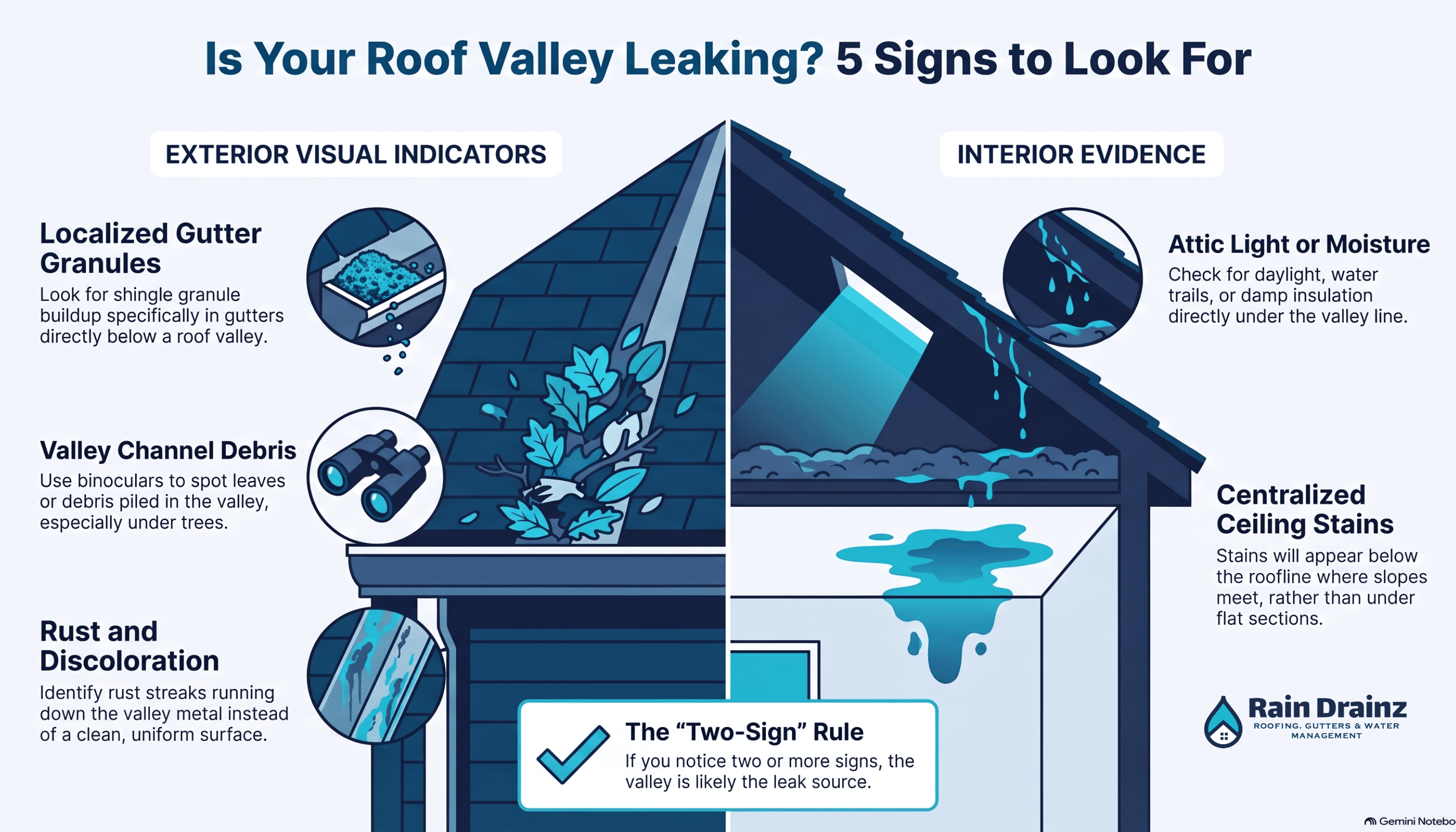
5 Signs Your Leak Is Coming From the Valley
Homeowners can check most of these signs from the ground or the attic without climbing on the roof. Look for the following before assuming the problem is somewhere else.
- Ceiling stains centered below a roofline where two slopes meet, rather than under a flat, open section of roof.
- Granule buildup in the gutter directly below the valley, which points to localized wear at that seam instead of roof-wide shingle aging.
- Debris piled visibly in the valley channel from the ground or with binoculars, especially under overhanging trees.
- Rust streaks or discoloration running down the valley metal rather than an even, clean surface.
- Daylight, water trails, or damp insulation in the attic directly under the valley line, checked with a flashlight on a dry day.
If you notice two or more of these signs, the valley is very likely the source, and it is worth scheduling a professional look before the next storm.
Rain Drainz has been tracing water paths back to their true source across Wilmington and New Castle County for over a decade.
If you are seeing any of these warning signs, our team can confirm the cause before recommending a fix. Reach out to us at Rain Drainz for a free estimate.
Valley Leaks vs. Other Common Culprits
Not every leak near a roofline is a valley problem. Wilmington roofs commonly fail at several other points, and it helps to know the difference before you call anyone out.
- A roof flashing leak can occur anywhere metal meets shingles, including walls, eaves, and dormers, not just in the valley itself.
- A chimney flashing leak shows up as a stain below the chimney chase and often traces back to cracked mortar joints in the counter-flashing rather than the valley.
- A skylight leak repair is usually needed when the seal around the frame fails, which produces a stain directly below the skylight instead of along a sloped seam.
- A general roof leak can also start from a cracked pipe boot or lifted shingles after high winds, which look similar to valley damage from inside the attic.
If the stain sits below a spot where two roof planes meet, and you notice debris or corrosion in that channel specifically, a valley problem is the most likely explanation.
Our Wilmington roof leak & flashing guide breaks down all five major leak zones in more detail if you want the full picture.
Can a Roof Valley Be Repaired Without Replacing the Whole Roof?
Yes, a valley leak can often be fixed without replacing the entire roof, as long as the surrounding shingles and decking are still sound.
Roof valley leak repair typically involves removing the damaged valley metal, checking the deck underneath for soft spots, and installing new flashing tied properly into the surrounding shingles to fully restore one of the most critical parts of your roof's drainage system.
A full roof replacement usually is not necessary when:
- The leak is isolated to one valley run rather than spread across multiple areas.
- The wood decking underneath tests dry and firm, with no soft spots or rot.
- The surrounding shingles are still in good condition with no widespread granule loss.
Replacement may be the smarter call when corrosion has spread beyond the valley itself, or when moisture testing reveals the decking has already absorbed water and softened.
A trained eye is the only reliable way to tell the difference, since both issues can produce the same ceiling stain.
Getting a Professional Diagnosis in Wilmington, DE
Guessing at a valley leak often leads to patching the wrong spot while the real entry point keeps leaking. A proper roof inspection checks the valley metal, surrounding shingles, and attic decking together, so the diagnosis is based on evidence rather than assumption.
If the valley flashing has failed, roof flashing installation using properly coated aluminum or copper will outperform bare galvanized steel in Wilmington's climate by years.
For leaks that are already active, our roof repair team traces the water path back to its true source before any work begins.
Rain Drainz is licensed and insured in Delaware (DE# 2023700737), GAF-certified, and holds a 4.9-star rating from 140+ local homeowners. You can view our reviews and location directly on our Google Business Profile.
Key Takeaways
- Roof valleys carry more water than any other section of a pitched roof, making them a common failure point in Wilmington.
- Ceiling stains below a valley, gutter granule buildup, and visible debris or rust are the clearest signs of a valley-specific leak.
- Valley leaks can usually be repaired without a full roof replacement if the deck and surrounding shingles are still sound.
- A professional inspection is the only way to confirm the true source before spending money on repairs.
Protecting Your Home Before the Next Storm
A roof valley leak rarely announces itself clearly. The signs are often subtle, from a small rust streak to a handful of extra granules in the gutter, and by the time a ceiling stain appears, water may have been traveling along the deck for weeks.
Checking for the signs covered in this guide gives you a starting point, but confirming the exact cause still requires a trained eye and the right tools.
Rain Drainz has spent over a decade diagnosing exterior water issues throughout Wilmington and New Castle County, and we know exactly where valleys tend to fail in this climate.
Contact us for a free written estimate today, and get a clear answer on where your leak is really coming from before you spend a dollar on repairs.

Frequently Asked Questions
Why does a roof valley leak?
A roof valley leaks because it channels the runoff from two roof slopes through a single, narrow metal seam that takes on far more water volume than any other part of the roof.
Over time, debris buildup, thermal expansion and contraction, and corrosion on older galvanized flashing all weaken that seam. Once a small gap opens, wind-driven rain can pass through even without a full metal failure.
How do you know if a leak is coming from the valley?
The clearest sign is a ceiling stain located below a spot where two roof planes meet, paired with visible debris, rust, or granule buildup in the gutter directly beneath that valley.
Checking the attic with a flashlight for daylight, water trails, or damp insulation under the valley line adds further confirmation. If two or more of these signs appear together, the valley is the likely source.
Can a roof valley be repaired without replacing the roof?
Yes, a roof valley can typically be repaired without a full roof replacement as long as the surrounding shingles are intact and the wood decking underneath has not softened from prolonged moisture exposure.
The repair involves removing the damaged valley metal and installing new flashing tied properly into the existing roof. Replacement becomes necessary only when corrosion or rot has spread well beyond the valley itself.