

If you’re asking how much does it cost to regrade a yard in Wilmington, the honest answer depends on how much of your lot needs new soil and how far the water has to travel once it leaves your foundation.
Wilmington’s clay-heavy subsoil holds water longer than sandy soil, which means even a small low spot near your house can turn into a standing puddle for days after a storm.
In 2026, most homeowners here pay somewhere between $600 and $11,000, depending on the scope. Here’s exactly where your project is likely to land.
The Real Answer: What Regrading Costs in Wilmington, DE (2026)
Pricing breaks down by project size, not a flat rate:
- Spot regrading (under 200 square feet, near the foundation): $600 to $1,400
- Moderate regrading (one problem zone, 200 to 800 square feet): $1,800 to $4,200
- Full-yard regrading with imported fill soil: $4,500 to $11,000 or more
- Regrading paired with a drainage tie-in (catch basin or French drain): $6,500 to $14,000 or more
A properly graded yard needs a minimum fall of 6 inches over the first 10 feet moving away from the house, roughly a 5 percent slope.
Anything flatter than 2 percent almost always ponds on Delaware’s clay soil, which absorbs water much more slowly than sandy ground.

What Is Yard Regrading, Exactly?
Yard regrading means cutting high spots, filling low ones, or importing new topsoil so the ground slopes away from your foundation instead of toward it. It’s a surface fix.
Regrading changes where rainwater travels once it hits the dirt, but it doesn’t touch water that’s already saturating the soil below the surface.
That distinction matters because it’s the reason some homeowners pay for a regrade and the wet spot comes back. If the real issue is groundwater sitting under a shallow clay layer, no amount of surface reshaping fixes it.
That’s a job for French drain installation, not a shovel and a load of topsoil.
Not sure if your yard needs regrading, a French drain, or both? Rain Drainz walks the full water path on your Wilmington property and gives you one honest recommendation instead of a guess. Click here for a free estimate before the next storm finds that same low spot again.
Yard Grading vs French Drain: How to Know Which One You Need
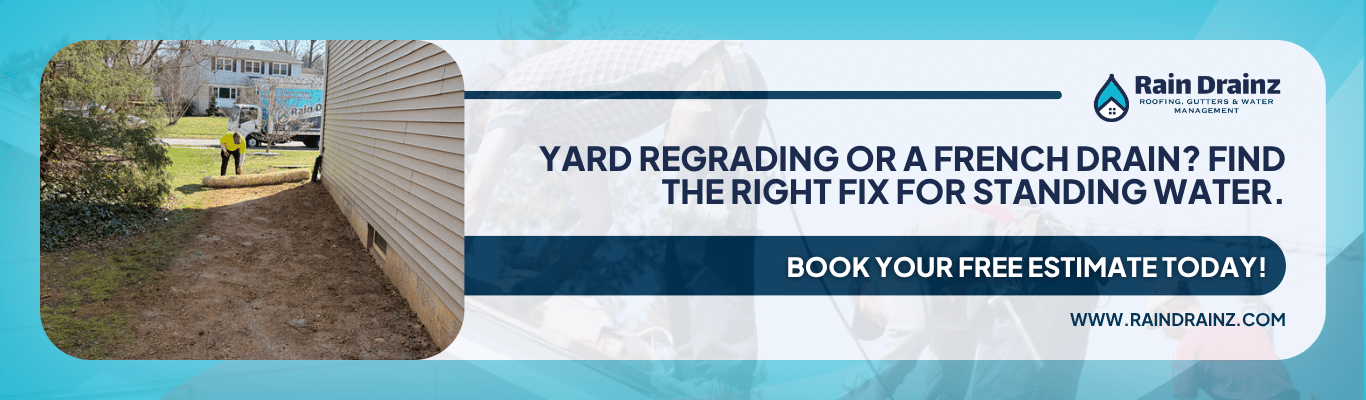
The yard grading vs. French drain question comes down to one simple test: how long does the water stay?
- If a puddle forms fast and drains completely within an hour or two once the rain stops, that’s a slope problem, and regrading fixes it.
- If the ground stays soft and spongy for two or three days with no visible puddle, that’s groundwater moving sideways under a clay layer, and regrading alone won’t solve it.
Rain Drainz has seen homeowners near Rockford Park spend $4,000 on a French drain for a wet strip that was actually a $1,800 grading fix, and the reverse happens just as often.
Walking the property first is the only way to know which layer of the problem you’re actually looking at.
What Drives Regrading Yard Cost Per Square Foot
Regrading yard cost per square foot moves based on a handful of specific factors:
- Imported fill soil. Clay lots often lack enough usable existing soil, so fill has to be trucked in and compacted in stages.
- Mature tree roots. Neighborhoods like Brandywine Hundred and Greenville have dense older tree canopy that limits how much soil can be cut without damaging root systems.
- Hardscape in the path. A patio, walkway, or retaining wall sitting in the regrading zone adds removal and replacement cost.
- Sod or seed restoration. Regrading disturbs the surface across the entire work area, so it needs to be stabilized afterward.
- Site access. Fenced yards or tight side lots slow equipment down and add labor time.
Flat lots in Bear and New Castle often need more fill volume simply because there’s less natural elevation to work with, while rolling terrain around Pike Creek and Hockessin sometimes needs regrading paired with a catch basin so the corrected slope doesn’t just speed water up.
Signs Your Wilmington Yard Actually Needs Regrading
Six signals point directly at a slope problem rather than a pipe or gutter issue:
- Standing water lasts more than 4 hours after rain stops
- Soil visibly slopes toward the foundation instead of away from it
- Erosion channels cut across the lawn or mulch beds
- Ice sheets form in the same low spot every winter
- New sod or landscaping didn’t fix it, meaning the underlying slope was never corrected
- Water pools near a downspout discharge point, often a combined grading and drainage issue
If you’re seeing two or more of these at once, especially a puddle that clears fast but a nearby patch that stays soft for days, you likely need a combined approach rather than one fix.
Rain Drainz’s full Yard Drainage Solutions page covers how catch basins, surface drains, and buried downspouts work together when grading alone isn’t enough.
Who to Hire to Regrade a Yard in Wilmington
Knowing who to hire to regrade yard projects matters more than the price quote itself. A landscaper can move soil, but if they don’t verify slope with a laser level and properly compact the fill, the low spot typically returns within a season or two.
That’s the most common reason DIY and budget regrading jobs fail on Delaware clay.
Rain Drainz is family-owned, licensed and insured in Delaware (DE# 2023700737), and has spent over a decade mapping how water moves across New Castle County’s clay-dominant soil.
Every regrading project starts with instrument-verified elevation mapping, not a walk-through guess, and every estimate is free and written before any work begins. You can see our reviews and service details on our Google Business Profile.
Key Takeaways
- Wilmington yard regrading typically costs $600 to $11,000+ depending on square footage and fill needed
- A properly graded yard needs at least a 5 percent slope, or 6 inches of fall over the first 10 feet
- Fast-draining puddles point to a grading fix; soggy ground that lingers for days points to groundwater and likely needs a French drain
- Hiring a contractor who verifies slope with a laser level, not a guess, is the difference between a permanent fix and a repeat problem
The Bottom Line on Regrading Your Wilmington Yard
Standing water in the same corner of your yard every storm season isn’t something that fixes itself, and paying for the wrong system twice gets expensive fast.
Whether your property needs simple spot regrading, a full-yard fill job, or a combined approach with exterior drainage, the right first step is getting an accurate read on where your water problem actually starts.
Rain Drainz has spent over ten years walking Wilmington properties roof to ground, and that local knowledge of New Castle County’s clay soil shapes every recommendation we make.
For a deeper breakdown of the full regrading process, timeline, and neighborhood-specific soil behavior, read our complete Yard regrading guide.
Ready to stop guessing and get a real number? Contact Rain Drainz for a free, written regrading assessment. We’ll tell you exactly what your yard needs, and just as importantly, what it doesn’t.
Frequently Asked Questions
How much does it cost to regrade a yard?
Regrading a yard in Wilmington, DE typically costs $600 to $1,400 for a small spot near the foundation, while full-yard projects with imported fill soil can run $4,500 to $11,000 or more.
The final number depends on square footage, how much fill needs to be trucked in, and whether trees or hardscape sit in the work area. Rain Drainz prices every project after a physical site visit rather than a phone estimate.
What is regrading a yard?
Regrading a yard means reshaping the slope of the soil, typically by cutting high spots and filling low ones, so rainwater flows away from the house instead of pooling against the foundation.
As noted by the Colorado State University Extension on soil drainage, proper grading is essential to ensure there are no low spots and that all surface water is directed safely away from structures.
It’s a surface-level correction that changes where water travels once it hits the ground, rather than a fix for water already saturating the soil underneath.
Is regrading cheaper than a French drain?
Regrading is often cheaper than a French drain when the problem is purely a slope issue, with spot regrading starting around $600 compared to $4,000 for a French drain installation.
However, they solve different problems, so choosing the cheaper option without confirming the actual cause can mean paying for the wrong fix and needing the correct one later.
How do you know if your yard needs regrading?
A yard needs regrading if standing water lasts more than four hours after rain, the soil visibly slopes toward the foundation, erosion ruts appear across the lawn, or ice forms in the same low spot every winter.
A laser-level site check from a professional confirms the exact slope and whether regrading alone will solve it.